Let’s be honest: the word “budget” can feel restrictive, complex, and even a little intimidating. It often conjures images of spreadsheets, complicated math, and saying “no” to everything you enjoy. But what if we reframed it? A budget isn’t a financial straitjacket; it’s a spending plan. It’s your GPS for your money, ensuring every dollar has a purpose and is working to get you where you want to go.
For Americans navigating a unique financial landscape—with its specific tax structures, retirement accounts, and consumer culture—having a budget isn’t just a good idea; it’s a fundamental skill for financial security and freedom. Whether you’re dealing with student loan debt, saving for a down payment on a home, or simply tired of wondering where your paycheck went, this guide is for you.
This step-by-step guide is designed for complete beginners. We will demystify the process, using American financial concepts and tools, to help you build a budget that is realistic, flexible, and empowering. By the end, you will have a clear plan for your money, reduced financial stress, and a concrete path toward achieving your goals.
Part 1: The Foundation – Mindset and Preparation
1.1. Shifting Your Money Mindset
Before we crunch numbers, let’s adjust our perspective. The goal of a budget is not to limit your joy but to fund your life according to your values. It’s about making conscious choices. Do you value travel? A budget helps you save for it. Is financial independence your dream? A budget is your primary tool to get there.
Action Step: Grab a notebook or open a document. Write down three financial goals:
- A short-term goal (e.g., “Pay off my $500 credit card balance in 3 months”).
- A mid-term goal (e.g., “Save $3,000 for a vacation next year”).
- A long-term goal (e.g., “Save for a down payment on a house” or “Contribute more to my 401(k)”).
These goals will be the “why” behind your budget, keeping you motivated.
1.2. Gathering Your Financial Documents
To build an accurate budget, you need a clear picture of your current financial reality. You’ll need to gather:
- Pay Stubs: Your last 2-3 pay stubs to understand your net income (take-home pay).
- Bank Statements: At least three months of statements from all checking and savings accounts.
- Credit Card Statements: The last three months for all cards.
- Bills & Receipts: For utilities, rent/mortgage, car payments, insurance, subscriptions, and any other recurring expenses.
- Investment & Loan Statements: For student loans, car loans, personal loans, and retirement accounts.
Pro Tip: Many of these are available digitally. Create a dedicated folder on your computer for this financial “fact-finding” mission.
Part 2: The Step-by-Step Budgeting Process
We will use a modified and simplified version of the popular 50/30/20 budget rule as our framework. This rule, popularized by Senator Elizabeth Warren in her book All Your Worth, is an excellent starting point for Americans as it aligns well with common income and expense structures.
The standard rule is:
- 50% for Needs: Essential expenses you must pay to live and work.
- 30% for Wants: Non-essential spending that enhances your lifestyle.
- 20% for Savings & Debt Repayment: Building your future and paying down debt.
We’ll adapt this into a practical, step-by-step process.
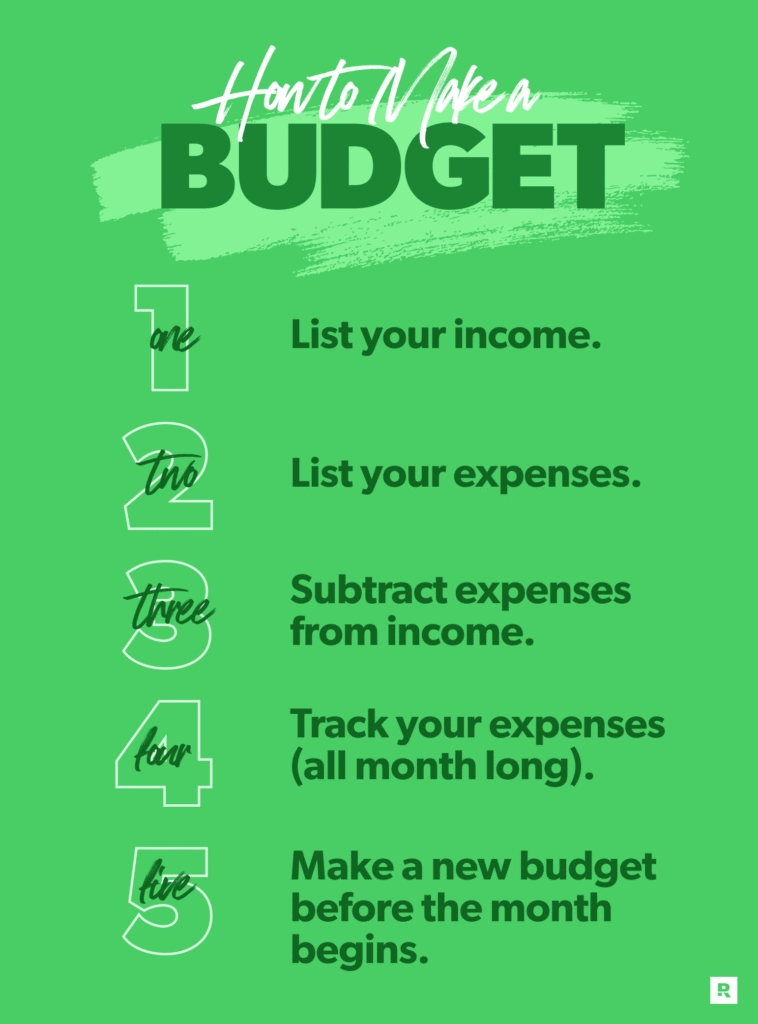
Step 1: Calculate Your Net Income
This is the most critical number. Your net income is your “take-home pay”—the amount that hits your bank account after taxes, health insurance premiums, retirement contributions (like a 401(k)), and other deductions are taken out.
- If you are a salaried employee: Use your monthly net pay from your pay stub.
- If you are an hourly employee or have variable income: Calculate a 3-month average of your net pay. (Add your net pay from the last three months and divide by three). This requires a more flexible budget, which we’ll address later.
- If you have side hustles: Use your average monthly net income from these activities.
Let’s use an example: Meet Alex, a fictional marketing coordinator in Chicago. Alex’s monthly net income is $4,000.
Step 2: Track and Categorize Your Expenses
Now, let’s see where your money is actually going. For one month, track every single dollar you spend. You can do this with a pen and paper, a notes app on your phone, or a budgeting app that links to your accounts (like Mint or Personal Capital).
Categorize each expense into one of three buckets:
Category A: Fixed Needs (Essential, Non-Negotiable)
These are your essential, recurring costs that are typically the same amount each month.
- Rent or Mortgage Payment
- Car Payment
- Insurance (Health, Auto, Renter’s/Homeowner’s)
- Minimum Debt Payments (Student Loans, Credit Cards) – Note: We’ll address extra payments later.
- Child Support or Alimony
- Utilities (Electric, Gas, Water, Sewer, Trash) – These can vary but are essential.
- Basic Groceries (Not dining out)
Category B: Variable Needs (Essential, But Fluctuating)
These are essential costs that can change from month to month.
- Gas / Public Transportation
- Essential Home & Car Maintenance
- Healthcare Co-pays & Prescriptions
- Basic Clothing (e.g., replacing worn-out work clothes)
Category C: Wants (Non-Essential, Lifestyle)
These are the discretionary expenses that make life enjoyable but are not essential for survival.
- Dining Out & Takeout
- Entertainment (Streaming Services, Movies, Concerts)
- Hobbies
- Travel
- Personal Care (Spa Treatments, Expensive Haircuts)
- Shopping for Non-Essentials (New Electronics, Fashion)
- Gym Memberships (Could be a “Need” for some, but often falls here)
Alex’s Expense Tracking:
- Rent: $1,200
- Student Loan Payment: $300
- Car Payment: $350
- Insurance (Car & Renter’s): $150
- Utilities & Internet: $200
- Groceries: $400
- Gas: $120
- Dining Out: $350
- Entertainment (Netflix, Hulu, going out): $150
- Shopping: $200
- Miscellaneous: $150
Step 3: Choose Your Budgeting Method & Allocate Funds
Now, let’s assign your income to your expenses using our adapted 50/30/20 framework.
First, calculate your total Needs (A + B):
Alex’s Needs = $1,200 (Rent) + $300 (Loan) + $350 (Car) + $150 (Insurance) + $200 (Utilities) + $400 (Groceries) + $120 (Gas) = $2,720
This is 68% of Alex’s $4,000 income ($2,720 / $4,000). This is over the ideal 50%, which is very common, especially with student loan debt and high rent in many US cities. Don’t panic. The 50/30/20 rule is a guideline, not a strict law. The goal is to optimize over time.
Next, calculate your Wants (C):
Alex’s Wants = $350 (Dining) + $150 (Entertainment) + $200 (Shopping) + $150 (Misc) = $850
This is 21.25% of income, which is under 30%. This is good news! It means there is some flexibility.
Finally, calculate what’s left for Savings & Debt Repayment:
Alex’s Income – Needs – Wants = $4,000 – $2,720 – $850 = $430
This $430 is 10.75% of income, going towards savings and debt. The goal is to get this to 20%.
Creating the Plan: The Zero-Based Budget
This is the most effective method. It means your income minus your expenses equals zero. Every dollar is assigned a job.
| Alex’s Zero-Based Budget (First Draft) | |
|---|---|
| Income | $4,000 |
| Needs (68%) | $2,720 |
| Wants (21.25%) | $850 |
| Savings & Debt (10.75%) | $430 |
| Total | $0 |
Step 4: Analyze and Optimize
Alex’s budget reveals a key challenge: Needs are too high. To free up more money for savings and debt, we need to scrutinize the “Needs” and “Wants” categories.
Strategies for Americans to Reduce “Needs”:
- Housing: Can you get a roommate? Negotiate rent renewal? Refinance your mortgage? (This is often the biggest lever).
- Insurance: Shop around for better rates on auto and renter’s insurance every 6-12 months.
- Groceries: Use apps like Ibotta or Rakuten for cashback. Plan meals and buy generic brands.
- Utilities: Reduce energy consumption. Call your internet provider and ask for a promotional rate.
- Debt: Look into Income-Driven Repayment (IDR) plans for federal student loans to lower the monthly payment. Consider the Debt Snowball or Debt Avalanche method for credit cards (more on this later).
Strategies to Reduce “Wants”:
- Audit Subscriptions: Cancel unused streaming services or gym memberships.
- The “Latte Factor”: Small, daily purchases add up. Making coffee at home a few days a week can save $50-$100/month.
- Implement a “No-Spend” Weekend: Challenge yourself to a weekend with no discretionary spending.
Alex’s Optimized Budget:
Let’s say Alex finds $150 in savings:
- Shops for cheaper car insurance: Saves $30/month.
- Cuts grocery bill by meal prepping: Saves $50/month.
- Cancels two streaming services and reduces dining out: Saves $70/month.
This $150 is moved from “Needs/Wants” to “Savings & Debt.” Now, Alex has $580 ($430 + $150) for this crucial category.
Step 5: Prioritize Savings and Debt Repayment
With the extra $580, Alex needs a plan. A general rule of thumb is to follow the “Personal Finance Hierarchy of Needs”:
- Build a Mini-Emergency Fund: First, save $500-$1,000 in a separate savings account for small, unexpected expenses. This prevents you from going into credit card debt when your car tire blows.
- Get Employer 401(k) Match: If your employer offers a 401(k) match, contribute enough to get the full match. This is free money and an instant 100% return on investment.
- Pay Off High-Interest Debt: Focus on credit card debt (APRs of 15-25%+). The interest is a massive drain on your finances.
- Debt Snowball: List debts from smallest to largest balance. Pay minimums on all, throw extra money at the smallest debt. This builds psychological wins.
- Debt Avalanche: List debts from highest to lowest interest rate. Pay minimums on all, throw extra money at the highest-rate debt. This saves the most on interest.
- Build a Full Emergency Fund: Once high-interest debt is gone, build an emergency fund with 3-6 months of essential expenses.
- Maximize Other Savings: Then, focus on other goals like saving for a house (in a High-Yield Savings Account), increasing 401(k) contributions, or investing in an IRA (Roth or Traditional).
Alex’s $580 Allocation:
- $300 extra toward credit card debt (using the Debt Avalanche method).
- $280 into a High-Yield Savings Account to build a 3-month emergency fund.
Read more: From Side Hustle to Full-Time: How To Scale Your Business in the American Market
Part 3: Tools and Tactics for Success
Choosing Your Budgeting Tool
- The Analog Method (Pen & Paper/Notebook): Simple, tactile, no tech required. Great for building mindfulness.
- The Digital Spreadsheet (Google Sheets/Excel): Powerful, customizable, and automatic calculations. You can find many free templates online.
- Budgeting Apps: The most popular choice for convenience.
- Mint (Free): Excellent for beginners. Automatically syncs with your accounts and categorizes transactions.
- YNAB (You Need A Budget) (~$15/month): A proactive, zero-based budgeting method with a strong educational component. Highly effective.
- Personal Capital / Empower (Free): Better for investment tracking and net worth, but has good budgeting features.
Advanced American-Specific Budgeting Considerations
- Tax Refunds: Don’t rely on a tax refund as part of your monthly budget. If you get a large refund, consider adjusting your W-4 form with your employer to have less tax withheld, thereby increasing your monthly take-home pay.
- Variable Income: If you’re a freelancer, gig worker, or commissioned salesperson, use your average monthly income as a baseline. In high-income months, set aside a large percentage (30-50%) for taxes and your emergency fund to cover low-income months. This is called the “Feast or Famine” method.
- Windfalls: Have a plan for bonuses, tax refunds, or gifts. Follow the 50/30/20 rule: 50% to future goals (debt/savings), 30% to fun, 20% to immediate obligations.
Part 4: Maintaining and Adapting Your Budget
Your budget is a living document. It will not be perfect the first month.
- Review Weekly: Do a quick 5-minute check-in to ensure you’re on track.
- Conduct a Monthly Budget Meeting: Sit down with yourself (and your partner, if applicable) at the end of the month. Compare your planned budget to your actual spending. What went well? What was off? Adjust categories for the next month.
- Life Happens: You will have unexpected expenses. That’s what the emergency fund is for. When it happens, don’t get discouraged. Adjust your budget and move forward.
- Celebrate Wins! When you pay off a debt or hit a savings goal, celebrate in a modest way that aligns with your budget. This positive reinforcement is key to long-term success.
Conclusion: Your Journey to Financial Control Starts Now
Building your first budget is the single most impactful step you can take toward financial well-being in the United States. It transforms money from a source of stress into a tool for building the life you want. It empowers you to tackle student loans, save for a home, invest for retirement, and sleep better at night knowing you have a plan.
Remember, perfection is the enemy of progress. Your first budget will be a rough draft. The goal is not to follow it perfectly but to become consciously engaged with your finances. Start today, be kind to yourself, and trust the process. You have the power to take control.
Read more: Navigating US Tax Obligations for Small Business Owners: A Beginner’s Checklist
Frequently Asked Questions (FAQ)
Q1: I’m living paycheck to paycheck. How can I possibly save money?
A: This is the most important time to budget. Start by tracking your spending ruthlessly for two weeks. You will almost certainly find “leaks”—small, recurring expenses you can eliminate. The $5-$10 saved each day adds up. Focus first on building that $500 mini-emergency fund. Even saving $20 per week gets you there in about six months. Every little bit counts and breaks the cycle.
Q2: What’s the difference between a Roth IRA and a Traditional IRA, and which should I choose?
A: This is a core American retirement question.
- Traditional IRA: Contributions are often tax-deductible in the year you make them. Your money grows tax-deferred, and you pay income tax when you withdraw it in retirement. Good if you think your tax bracket will be lower in retirement.
- Roth IRA: Contributions are made with after-tax dollars (no upfront tax break). Your money grows tax-free, and you pay no taxes on qualified withdrawals in retirement. Excellent for young people who are in a lower tax bracket now than they will be in the future.
For most beginners starting their first budget, a Roth IRA is often the recommended starting point.
Q3: Should I save for retirement or pay off debt first?
A: It’s not always an “either/or.” Follow the hierarchy outlined in the article:
- Get your 401(k) employer match (it’s free money).
- Pay off high-interest debt (especially credit cards over 7-10% APR).
- Then, split your efforts between building a full emergency fund and increasing retirement savings. The emotional and financial burden of high-interest debt is often greater than the potential investment returns you might miss.
Q4: How can I budget for irregular expenses like car registration or holiday gifts?
A: This is a key to avoiding budget busters. List all your annual or semi-annual expenses and their costs. Add them up and divide by 12. That is the amount you need to set aside each month in a separate “Sinking Fund” savings account. For example, if you spend $600 on holiday gifts, save $50 per month all year long.
Q5: What if my budget doesn’t work after the first month?
A: This is completely normal and expected! Your first budget is an educated guess. The monthly review process is where the real learning happens. If you overspent in one category (e.g., groceries), see if you can reduce another category (e.g., dining out) to compensate, or adjust your grocery budget for the next month to be more realistic. A budget is a flexible tool that you calibrate over time.