Student loan debt in the United States is more than a financial issue; it’s a defining reality for over 45 million borrowers, shaping life decisions about careers, homes, and families. If you feel overwhelmed by your student loans, you are not alone. The complex maze of repayment plans, forgiveness programs, and lender terminology can feel paralyzing. However, with the right knowledge and a proactive strategy, you can transition from feeling controlled by your debt to being in command of your financial future.
This guide is designed to be your comprehensive roadmap. We will demystify the process, break down your options into actionable steps, and provide you with the tools to create a personalized repayment strategy. We will cover everything from the fundamental basics of understanding your loans to exploring income-driven repayment plans, public service forgiveness, and strategies for accelerating repayment.
Part 1: The Foundation – Knowing Your Loans and Key Concepts
Before you can effectively manage your debt, you must know exactly what you’re dealing with. This foundational step is non-negotiable.
1.1. Federal vs. Private Loans: The Critical Distinction
The single most important factor determining your options is who lent you the money.
Federal Student Loans: These are funded by the U.S. Department of Education. They come with a suite of borrower protections and benefits that are not typically available with private loans.
- Key Features:
- Fixed Interest Rates: Set by Congress, these rates do not change for the life of the loan.
- Income-Driven Repayment (IDR) Plans: Your monthly payment is capped at a percentage of your discretionary income.
- Loan Forgiveness Programs: Such as Public Service Loan Forgiveness (PSLF) and forgiveness after 20-25 years on an IDR plan.
- Deferment and Forbearance: Options to temporarily pause payments during times of economic hardship, with certain types of deferment not accruing interest.
- Subsidized Loans: For undergraduate students with financial need, the government pays the interest while you are in school at least half-time and during deferment periods.
Private Student Loans: These are offered by banks, credit unions, and other financial institutions. Their terms and conditions are dictated by the lender and your creditworthiness.
- Key Features:
- Variable or Fixed Rates: Often start with lower rates but variable rates can increase significantly over time.
- Fewer Repayment Options: Typically, you must choose between a standard 10-year plan or an extended plan. Income-driven plans do not exist.
- Limited Forbearance: Some lenders offer short-term forbearance, but it’s not guaranteed and interest always accrues.
- No Federal Forgiveness Programs: Private loans are not eligible for PSLF or IDR forgiveness.
- May Require a Co-signer: Often necessary for students without an established credit history.
Actionable Step: Your first task is to categorize every single one of your student loans.
1.2. Locate Your Loan Details
For Federal Loans, the primary source is the U.S. Department of Education’s Federal Student Aid (FSA) website. Log in using your FSA ID (the same one you used for the FAFSA). Your dashboard will show:
- Loan Servicer(s): The company that handles your billing and other services. This is your primary point of contact for federal loans.
- Loan Types: (e.g., Direct Subsidized, Direct Unsubsidized, PLUS).
- Current Balance: For each individual loan.
- Interest Rate: For each loan.
- Repayment Status: (e.g., In Repayment, Grace Period, Forbearance).
For Private Loans, check your credit report for free at AnnualCreditReport.com or dig through your personal records and email to find your original lender. You may need to contact them directly to get all the details.
1.3. Master the Key Terminology
- Principal: The original amount of money you borrowed, not including interest.
- Interest: The cost of borrowing money, expressed as a percentage of the principal.
- Capitalization: When unpaid interest is added to your principal balance. This increases the total amount you owe interest on. This can happen when your grace period ends, or you leave a deferment/forbearance.
- Loan Servicer: A company that manages your student loan billing, payments, and customer service. They are not the lender for federal loans but act on behalf of the Department of Education.
- Grace Period: A period (usually six months for federal loans) after you graduate, leave school, or drop below half-time enrollment before you must begin making payments.
- Default: The failure to repay a loan according to the terms. For federal loans, this typically occurs after 270 days of non-payment and has severe consequences, including wage garnishment, withholding of tax refunds, and a devastating impact on your credit score.
Part 2: Your Federal Student Loan Repayment Plan Options
Federal student loans offer a variety of repayment plans. Choosing the right one is the cornerstone of your strategy.
2.1. Standard Repayment Plan
- What it is: A fixed monthly payment designed to pay off your loan in 10 years (or up to 30 years for Consolidation Loans).
- Best for: Borrowers who can afford the monthly payment and want to minimize total interest paid. This is the fastest and cheapest way to repay your loans.
- Monthly Payment: Higher than other plans, but the loan term is shorter.
2.2. Graduated Repayment Plan
- What it is: Payments start lower and increase every two years, designed to pay off your loan in 10 years (or up to 30 years for Consolidation Loans).
- Best for: Borrowers who expect their income to steadily increase over time.
- Monthly Payment: Starts lower than the Standard plan but ends up being higher.
2.3. Extended Repayment Plan
- What it is: Extends your repayment term to up to 25 years, resulting in lower monthly payments. You can choose fixed or graduated payments.
- Best for: Borrowers with more than $30,000 in federal loan debt who need lower monthly payments.
- Monthly Payment: Lower than the Standard or Graduated plans, but you will pay more in total interest over the life of the loan.
2.4. Income-Driven Repayment (IDR) Plans: A Game-Changer
IDR plans are powerful tools that cap your monthly payment at a percentage of your “discretionary income.” They are the gateway to long-term forgiveness. Your payment can be as low as $0 per month if your income is low enough.
How Discretionary Income is Calculated: Generally, it’s the difference between your Adjusted Gross Income (AGI) and 150% of the poverty guideline for your family size and state.
There are four main IDR plans:
1. Saving on a Valuable Education (SAVE) Plan
(This plan replaced the REPAYE plan and offers the most generous terms for many borrowers.)
- Payment Cap: 10% of your discretionary income. As of July 2024, this will be reduced to 5% for undergraduate loans.
- Benefit for Low Incomes: If your calculated payment doesn’t cover the monthly interest, the government waives the remaining interest. This prevents your balance from growing due to unpaid interest.
- Forgiveness Timeline: 20 years for undergraduate loans, 25 years for loans from graduate or professional studies.
- Best for: Almost all borrowers, especially those with low income relative to their debt, or those who have a mix of undergraduate and graduate loans.
2. Pay As You Earn (PAYE) Plan
- Payment Cap: 10% of your discretionary income, but never more than the Standard Repayment Plan amount.
- Forgiveness Timeline: 20 years.
- Best for: Borrowers who are new borrowers (as of Oct. 1, 2007) and have a high debt-to-income ratio.
3. Income-Based Repayment (IBR) Plan
- Payment Cap: For new borrowers (on or after July 1, 2014), it’s 10% of discretionary income. For earlier borrowers, it’s 15%. Payments never exceed the Standard plan amount.
- Forgiveness Timeline: 20 years for new borrowers (10% payments), 25 years for earlier borrowers (15% payments).
- Best for: Borrowers who do not qualify for PAYE or find SAVE less beneficial for their specific situation.
4. Income-Contingent Repayment (ICR) Plan
- Payment Cap: The lesser of 20% of your discretionary income or what you would pay on a fixed 12-year repayment plan.
- Forgiveness Timeline: 25 years.
- Best for: Parent PLUS borrowers (who can only access ICR by consolidating) or borrowers married to someone with whom they file taxes separately.
Actionable Step: Use the Loan Simulator on the FSA website. It is an invaluable, official tool that allows you to compare all your payment plan options based on your actual loan data.
Part 3: Specialized Federal Programs and Strategies
3.1. Public Service Loan Forgiveness (PSLF)
PSLF is a powerful program for those working in public service, but it has strict, non-negotiable rules.
The Requirements:
- Employment: Work full-time for a U.S.-based government organization (federal, state, local, or tribal) or a qualifying 501(c)(3) not-for-profit organization.
- Loans: Must have Direct Loans. If you have FFEL or Perkins Loans, you must consolidate them into a Direct Consolidation Loan to become eligible.
- Repayment Plan: Must be on an income-driven repayment plan or the 10-Year Standard Repayment Plan.
- Payments: Must make 120 qualifying monthly payments (10 years’ worth). These do not need to be consecutive.
Critical Action: Submit the PSLF Employment Certification Form (ECF) annually, or every time you change jobs. This allows the Department of Education to track your progress and correct any issues early. The Temporary Expanded PSLF (TEPSLF) program has also provided relief for some borrowers who were in the wrong repayment plan.
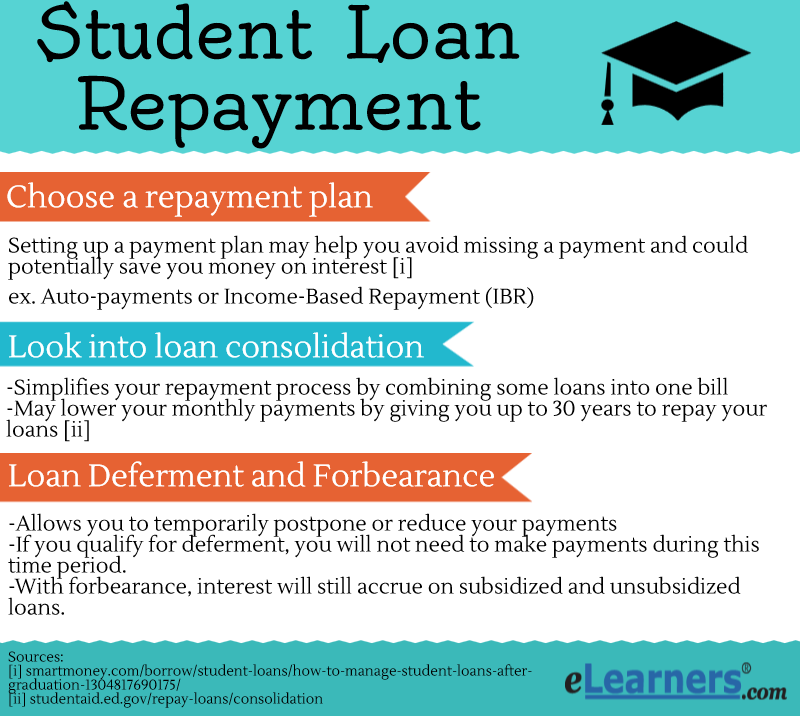
3.2. Loan Consolidation
Consolidation combines multiple federal loans into one single Direct Consolidation Loan, with a fixed interest rate that is the weighted average of your existing loans (rounded up to the nearest one-eighth of a percent).
When to Consider Consolidation:
- To make FFEL or Perkins Loans eligible for PSLF or IDR plans.
- To simplify repayment by having a single monthly payment.
- To gain access to alternative repayment plans not available on your current loans.
When NOT to Consolidate:
- If you are close to achieving PSLF or IDR forgiveness, as consolidation resets your payment count to zero.
- If you have loans with different interest rates and you are aggressively paying off the highest-interest loans first.
- If it causes you to lose benefits specific to your current loans (e.g., some Perkins Loan cancellation benefits).
3.3. Deferment and Forbearance: Use Sparingly
These are options to temporarily postpone payments.
- Deferment: Preferred option for federal loans. For certain types (like unemployment or economic hardship deferment), you may not be responsible for paying the interest on subsidized loans during the deferment period.
- Forbearance: Interest accrues on all loan types during forbearance. If you don’t pay the interest, it will capitalize (be added to your principal balance).
Use these as a last resort. Exhaust all other options, such as switching to an IDR plan where your payment could be $0, before requesting a forbearance.
Part 4: Strategies for Private Student Loans
Private loans lack the flexible safety nets of federal loans, so your strategy must be different.
- Refinancing: This is the most powerful tool for managing private loans. Refinancing involves taking out a new loan from a private lender to pay off your existing student loans. The goal is to secure a lower interest rate or a different loan term.
- When it makes sense: You have a stable income, good to excellent credit (typically 690+), and a low debt-to-income ratio. If you can secure a significantly lower interest rate, you can save thousands.
- The Major Risk: When you refinance federal loans, you lose access to all federal benefits—IDR, PSLF, deferment, and forbearance. This is a permanent, irreversible decision. It is generally not advisable unless you are certain you will not need these protections.
- Contact Your Lender Immediately if You Struggle: Private lenders do not have to offer help, but many have hardship programs. If you are struggling to make payments, call them. Explain your situation and ask about options for a modified payment plan or a temporary interest-rate reduction.
- Make Extra Payments: Since there are no forgiveness options, the best way to manage private loan debt is to pay it off aggressively. Always specify that extra payments should be applied to the principal balance.
Read more: A Step-by-Step Guide To Legally Registering Your Business in Any US State
Part 5. Creating Your Personalized Action Plan
Follow these steps to take control of your student debt today.
Step 1: Triage and Information Gathering (1-2 Hours)
- Log in to your FSA dashboard and download your loan data.
- List every loan: servicer, type, balance, interest rate.
- For private loans, gather the same information from your lender or credit report.
Step 2: Analyze Your Financial Reality (1 Hour)
- Calculate your total monthly pre-tax income.
- Create a basic budget to understand your essential expenses (housing, food, transportation, utilities).
- Determine how much you can realistically allocate to student loans each month beyond a minimum IDR payment.
Step 3: Model Your Scenarios (1-2 Hours)
- Use the FSA Loan Simulator. Input your loan and income data.
- Compare the outcomes of different plans: Standard vs. SAVE vs. PAYE, etc.
- See how much you would pay monthly, total over time, and potential forgiveness amounts.
Step 4: Choose and Implement Your Strategy (1 Hour)
- If you need low payments and work in public service: Enroll in an IDR plan (like SAVE) and submit your PSLF Employment Certification Form immediately.
- If you need low payments but don’t qualify for PSLF: Enroll in an IDR plan (SAVE is often best) and plan for forgiveness in 20-25 years. Be aware that forgiven amounts under IDR may be considered taxable income.
- If you have a high income and want to pay off debt fast: Stick with the Standard Plan or pay even more than the minimum. Use the debt avalanche method (targeting loans with the highest interest rates first) to minimize total interest.
- If you have high-interest private loans: Shop around for refinancing offers from credible lenders to lower your rate.
Step 5: Automate and Monitor (Ongoing)
- Set up auto-pay with your servicer. Most servicers offer a 0.25% interest rate reduction for this.
- Mark your calendar to re-evaluate your plan annually or whenever you have a major life change (new job, marriage, salary increase).
Part 6: What to Do If You’re Struggling or in Default
Ignoring your student loans will only make the problem worse. If you are in danger of missing a payment or are already in default, take action now.
For Federal Loans in Default:
- Loan Rehabilitation: This is often the best option. You agree to make nine affordable, voluntary, on-time monthly payments within 20 days of their due date over ten consecutive months. The payment amount is based on your income and is often very low. Once completed, the default status is removed from your loans, and you regain eligibility for benefits like deferment and IDR.
- Loan Consolidation: You can get out of default quickly by consolidating your defaulted loans into a new Direct Consolidation Loan. You must either agree to repay the new loan under an IDR plan or make three consecutive, on-time, voluntary payments on the defaulted loans before consolidating.
For Private Loans in Default:
Your options are more limited. Contact the lender or collection agency to negotiate a settlement or payment plan. Consider consulting a non-profit credit counseling agency for assistance.
Conclusion: Empowerment Through Knowledge
Managing student loan debt is a marathon, not a sprint. It requires patience, organization, and a clear understanding of the tools at your disposal. The landscape can change with new legislation and programs, so staying informed is crucial. By taking the steps outlined in this guide—knowing your loans, exploring all repayment options, and creating a proactive plan—you can move from a place of stress and uncertainty to one of confidence and control. Your student loans are a financial obligation, but they do not have to define your life. You have the power to manage them effectively and build the future you envision.
Read more: How To Choose the Right Business Structure in the USA: LLC, S-Corp, or Sole Proprietorship?
Frequently Asked Questions (FAQ)
Q1: I have multiple loans with different servicers. Is there any way to combine them into one payment?
Yes, for federal loans, you can use a Direct Consolidation Loan to combine them into a single loan with one servicer and one monthly payment. For private loans, you can explore refinancing, which pays off your old loans and gives you one new loan with a single lender. Remember the key differences: federal consolidation preserves federal benefits, while private refinancing eliminates them.
Q2: Is student loan forgiveness taxable?
It depends on the program and the state you live in.
- Public Service Loan Forgiveness (PSLF): The amount forgiven is NOT considered taxable income by the federal government.
- Income-Driven Repayment (IDR) Forgiveness: Under current federal law, the forgiven amount IS considered taxable income. You would receive a 1099-C form and owe taxes on that amount in the year it is forgiven. There are legislative efforts to change this, but it is the law as of now. Some states also conform to this taxability, while others do not.
- ** Borrower Defense to Repayment:** Not taxable.
Q3: What is the best way to pay off my student loans faster?
- Make Bi-weekly Payments: Instead of one monthly payment, pay half every two weeks. This results in one extra full payment per year.
- Use the Debt Avalanche Method: Make minimum payments on all loans, but put any extra money toward the loan with the highest interest rate. This mathematically minimizes the total interest you pay.
- Apply Windfalls: Use tax refunds, work bonuses, or gifts to make lump-sum payments toward your principal balance.
- Round Up Payments: If your payment is $287, round up to $300 or $350 consistently.
Q4: I’m on an IDR plan. Why is my monthly payment $0?
A $0 payment is not “free money.” It means your calculated discretionary income is $0 or negative based on your family size and Adjusted Gross Income (AGI). These $0 payments count as qualifying payments toward both PSLF (if you meet other requirements) and IDR forgiveness. On the SAVE plan, the government will also cover any unpaid monthly interest, so your balance won’t grow.
Q5: Can I change my repayment plan if my financial situation changes?
Yes, you can change your federal repayment plan at any time for free. There is no limit to how many times you can switch. If you get a higher-paying job, you might switch from an IDR plan to the Standard plan to pay off your loans faster. If you lose your job, you can switch from Standard to an IDR plan to lower your payments. Contact your loan servicer to request a change.
Q6: Should I prioritize paying off student loans or saving for retirement?
This is a personal decision, but a common strategy is to do both simultaneously, especially if your employer offers a 401(k) match.
- Contribute enough to your 401(k) to get the full employer match—this is a 100% return on your investment.
- Pay down student loans with interest rates above 6-7% aggressively.
- Once high-interest debt is managed, you can split your focus between additional retirement savings and lower-interest student debt.
Q7: What happens to my student loans if I die?
- Federal Student Loans: The debt is discharged (forgiven) upon the death of the borrower. The same is true if a parent who took out a Parent PLUS loan dies.
- Private Student Loans: Policies vary by lender. Some may discharge the debt, but others may try to collect from the borrower’s estate. It is critical to read your promissory note and understand your lender’s specific policy.
Q8: Are there any legitimate student loan forgiveness programs outside of the government?
Be extremely cautious. Scams are rampant. Legitimate forgiveness programs are run by the federal or state government. You never have to pay to apply for forgiveness. Any company that promises forgiveness or debt elimination for an upfront fee is a scam. All the information and applications for federal programs are available for free on the FSA website or through your official loan servicer.