In an era where the gig economy is booming and the desire for flexible, meaningful work is at an all-time high, starting a side hustle has become a quintessentially American pursuit. Among the myriad of options, Etsy stands out as a unique and powerful platform. It’s not just a marketplace; it’s a global community dedicated to unique, creative, and handmade goods, vintage items (over 20 years old), and craft supplies.
For the aspiring entrepreneur in the USA, Etsy offers a low-barrier-to-entry platform with a built-in audience of millions of buyers specifically searching for items that aren’t mass-produced. In 2023, Etsy reported 96.3 million active buyers, a testament to the robust demand for its unique inventory. Whether you’re a crafter, artist, vintage collector, or designer, your side hustle on Etsy can transform your passion into a steady stream of supplemental income.
This guide is designed to be your definitive roadmap. We will walk you through every single step, from the initial spark of an idea to managing your finances and scaling your budding business—all while navigating the specific legal and financial landscape of the United States.
Phase 1: Laying the Groundwork for Your Etsy Shop
Success on Etsy doesn’t happen by accident. It’s the result of careful planning and strategic execution. Before you list your first item, you must complete this crucial foundational phase.
Step 1: Find Your Niche and Validate Your Idea
The biggest mistake new sellers make is being too generic. “Jewelry” is not a niche; “Minimalist Sterling Silver Jewelry for Professional Women” is.
- Leverage Your Skills and Passions: What do you love to make? What skills do you possess? Knitting, woodworking, digital design, calligraphy, candle making? Your passion will fuel you when the work gets tough.
- Conduct Market Research on Etsy: This is non-negotiable. Go to Etsy.com and search for your potential product ideas.
- Analyze Competitors: Look at the top-selling listings. What are they selling? What are their prices? Read their reviews to see what customers love and what’s missing.
- Identify Gaps: Can you do it better, more uniquely, or with a specific theme (e.g., Star Wars-themed baby clothes, rustic farmhouse decor)?
- Use Etsy’s Built-in Data: While tools like eRank or Marmalee offer deeper analytics, you can get started by simply typing a keyword into Etsy’s search bar. The auto-complete suggestions will show you what buyers are actively searching for.
- Consider Profitability: Calculate your Cost of Goods Sold (COGS). This includes:
- Raw materials
- Labor (pay yourself an hourly rate!)
- Packaging
- Etsy fees (we’ll detail these later)
- Shipping costs
Your price must cover all of these and leave you with a healthy profit margin. A good starting point is to aim for a 50-60% margin.
Step 2: Understand the Legalities: Business Structure & Taxes in the USA
This is the most daunting but critical part for American sellers. Getting it right from the start saves massive headaches later.
- Choose a Business Name: Select a name that is memorable, reflects your brand, and is available as a domain name (even if you don’t plan a website now). Check for its availability on Etsy and with your state’s Secretary of State.
- Apply for an Employer Identification Number (EIN): While you can use your Social Security Number (SSN) as a sole proprietor, an EIN (free from the IRS) is highly recommended. It protects your SSN and makes you look more professional.
- Determine Your Business Structure:
- Sole Proprietorship: The simplest and most common for beginners. You and your business are legally the same. It’s easy to set up but offers no personal liability protection.
- Limited Liability Company (LLC): Highly recommended as your business grows. An LLC separates your personal assets (your home, car, personal bank account) from your business liabilities. If your business is sued, your personal assets are generally protected. The setup cost varies by state ($50 – $500).
- Set Up a Separate Bank Account: Do NOT mix personal and business finances. Open a dedicated checking account for your Etsy side hustle. This is crucial for clean bookkeeping and tax preparation.
- Understand Sales Tax: Etsy automatically collects and remits sales tax for most states on your behalf. However, you are still responsible for:
- Income Tax: Your Etsy profit is taxable income. You must report it on your federal tax return (Schedule C) and likely your state return.
- Estimated Quarterly Taxes: If you expect to owe $1,000 or more in taxes for the year, the IRS requires you to make quarterly estimated tax payments. Use Form 1040-ES. Failure to do so can result in penalties.
Disclaimer: I am an experienced e-commerce seller, not a CPA or lawyer. This is general guidance. It is highly recommended that you consult with a tax professional or attorney for advice specific to your situation.
Step 3: Source Your Materials & Dial In Your Production
- Source Quality Materials: Whether it’s fabric from Jo-Ann, specialty wood from a local lumberyard, or supplies from a wholesaler like Uline or Nashville Wraps, consistency and quality are key.
- Create a Prototype: Make a sample of your product. Test it. Photograph it. Does it look as good as you imagined? Is the process efficient?
- Systemize Your Production: Create a batch process. Instead of making one item from start to finish, cut materials for 10 items, then assemble all 10, then package all 10. This “assembly line” approach dramatically increases efficiency.
Phase 2: Setting Up Your Etsy Shop for Success
Now for the fun part: building your storefront. Your shop is your digital first impression—make it count.
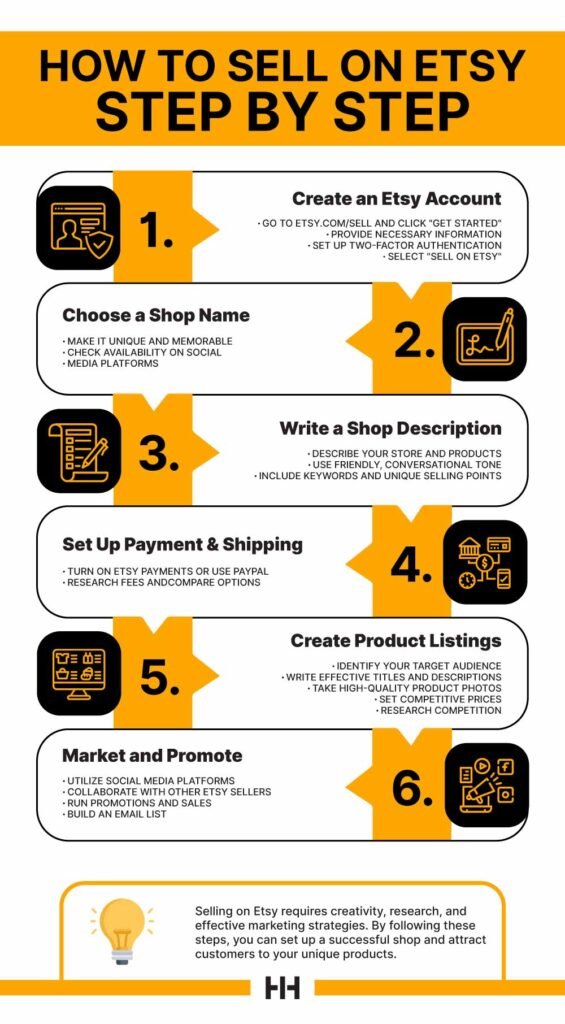
Step 4: Create Your Etsy Seller Account & Shop
- Go to Etsy.com and click “Sell on Etsy.”
- Click “Open your Etsy shop.”
- You’ll be guided through:
- Your Preferences: Choose your language, country (USA), and currency (USD).
- Shop Name: Use the name you decided on in Step 2. Make it brandable and easy to remember.
- Listing Your Items: We’ll cover this in-depth next.
- Billing: Set up your payment method to pay for Etsy fees. You can use a credit/debit card.
- Bank Account: Connect your dedicated business checking account to get paid. Etsy deposits your funds daily, weekly, or bi-weekly.
Step 5: The Anatomy of a High-Converting Listing
Your listing is your salesperson. It must inform, entice, and convert a browser into a buyer.
- Photos are EVERYTHING: You need a minimum of 7-10 high-quality, well-lit photos.
- Hero Shot: The first image must be stunning and clearly show the product.
- Context Shots: Show the product in use (a coaster under a mug, a necklace on a person).
- Detail Shots: Close-ups of the texture, craftsmanship, or unique features.
- Scale Shot: Include an object for scale (a coin, a hand) so buyers understand the size.
- Packaging Shot: Show how beautifully it will be presented when it arrives.
- Craft a Killer Title: Your title is prime SEO real estate. Don’t just write “Wooden Coaster.” Use all 140 characters.
- Formula: Primary Keyword + Descriptive Adjective + Material + Use Case/Gift Idea
- Example: “Personalized State Coaster, Engraved Wood Coaster Set of 4, Custom Map Art, Housewarming Gift, Rustic Home Decor for Him”
- Write a Compelling Description: This is your sales copy. Don’t just describe what it is; describe what it does for the buyer.
- Tell a Story: Why did you make it? What inspired you?
- Highlight Benefits: “Handmade from solid walnut for a durable, heirloom-quality piece.” “The perfect, unique gift for a wedding or anniversary.”
- Use Scannable Formatting: Use bullet points, bold text, and short paragraphs.
- Include Details: Dimensions, materials, care instructions, and processing time.
- Price Strategically: Your price should reflect your COGS, Etsy fees, and the value you provide. Research competitor pricing but don’t engage in a race to the bottom. Undercutting devalues your work and the entire handmade market.
- Inventory & Attributes: Fill out every single attribute (color, style, occasion, etc.). This helps Etsy’s algorithm and filter searches, making your item easier to find.
Step 6: Master Etsy SEO (Search Engine Optimization)
Etsy has its own search engine, “Marmot.” To get found, you need to speak its language.
- Keywords are King: Your keywords should be sprinkled throughout your Title, Tags, and Attributes.
- Tags: You get 13 tags. Use every single one. Use a mix of broad and specific phrases (e.g., “gift for her,” “personalized necklace,” “birthstone jewelry,” “mom necklace”).
- Think Like a Buyer: What words would a customer type into the search bar to find your product?
- Learn from Your Stats: Once your shop is open, Etsy provides shop stats. Pay attention to which listings get the most views and where those views come from (Etsy search, direct traffic, etc.). Double down on what works.
Phase 3: Operating and Growing Your Business
The shop is open! Now, the real work begins.
Step 7: Master Fulfillment and Shipping
A great unboxing experience creates repeat customers and stellar reviews.
- Packaging: Your packaging is part of the product. Use branded tissue paper, a thank-you note, and secure packaging to prevent damage. A simple, handwritten “Thank You!” note goes a long way.
- Shipping in the USA:
- Etsy Shipping Labels: Purchase your shipping labels directly through Etsy. You get Commercial Plus Pricing (a discount), and the tracking is automatically uploaded.
- USPS vs. UPS vs. FedEx: For small, lightweight packages, USPS First Class Package is often the cheapest. For heavier items, compare USPS Priority Mail with UPS and FedEx ground services.
- Free Shipping: Etsy favors listings with free shipping. Consider baking the shipping cost into your item price and offering “Free US Shipping.” Alternatively, use Etsy’s “Free Shipping Guarantee” on orders over $35.
Step 8: Provide Stellar Customer Service
- Respond Quickly: Answer customer messages within 24 hours, but aim for sooner.
- Be Professional and Kind: Even in the face of a difficult customer, remain courteous and solution-oriented.
- Handle Problems Gracefully: If an item gets lost or broken, have a clear policy but be willing to replace or refund. The cost of one lost item is far less than the lifetime value of a happy customer and a protected 5-star rating.
- Process Orders Promptly: Keep your processing times realistic and stick to them. If you get behind, communicate with the buyer.
Read more: A Rare gem Awaits you at Kukatpally, Hitech City – Honer Sigantis Book Now at ₹1.85 Cr
Step 9: Drive Traffic and Market Your Shop
Don’t rely solely on Etsy search. Be the driver of your own traffic.
- Leverage Social Media:
- Instagram & Pinterest are visual platforms perfect for Etsy. Show behind-the-scenes clips, beautiful flat lays of your products, and customer photos.
- TikTok: Short videos showing your creation process can go viral and drive massive traffic.
- Use Hashtags: Research relevant hashtags to increase your reach.
- Collect Email Addresses: From the first sale, start building an email list. Include a small card in your packages inviting customers to join for updates or a discount on their next order. This gives you a direct marketing channel outside of Etsy.
- Encourage Reviews: Etsy automatically asks buyers to leave a review after they receive their item. You can gently nudge them by including a note in your package like, “We’d love to hear what you think!” Never explicitly ask for a 5-star review.
Step 10: Manage Your Finances Like a Pro
This brings us back to the legal groundwork. Now you have to manage the money.
- Track Everything: Use a simple spreadsheet or accounting software like QuickBooks Self-Employed to track every sale, fee, and expense.
- Understand Etsy Fees: Know what you’re paying.
- Listing Fee: $0.20 per listing (each time you list an item, it lasts 4 months).
- Transaction Fee: 6.5% of the total sale price (including shipping).
- Payment Processing Fee: 3% + $0.25 of the total amount charged to the buyer.
- Offsite Ads Fee: If Etsy brings a customer from an external ad (Google, etc.), you pay a 12-15% fee on that sale. You can opt out if you make under $10,000 in a 12-month period.
- Set Aside Money for Taxes: Open a high-yield savings account and automatically transfer 25-30% of every payout into it. This is for your quarterly and annual taxes. Do not touch this money.
Conclusion: Your Journey Starts Now
Starting a profitable Etsy side hustle is a marathon, not a sprint. It requires creativity, strategic planning, and a healthy dose of perseverance. There will be slow days and frustrating moments, but there will also be the incredible thrill of your first sale, the joy of a glowing review, and the empowerment of building something that is truly your own.
You now have the complete blueprint. The steps are clear:
- Plan: Find your niche and understand the legalities.
- Build: Create a beautiful, SEO-optimized shop.
- Operate: Deliver amazing products and customer service.
- Grow: Market your business and manage your finances.
The most important step is the first one. Take action today. Brainstorm one product idea, research it on Etsy, and take that first, brave step toward launching your own profitable American side hustle.
Read more: Mr. Chirag’s Ultimate Option Selling Strategy – Learn For Free
Frequently Asked Questions (FAQ)
Q1: How much money do I need to start an Etsy shop?
The cost is relatively low. You’ll need funds for your initial inventory/materials and packaging. The direct cost to open the shop is just the $0.20 listing fee per item. However, you should have a small budget for tools, shipping supplies, and potential business registration (like an LLC).
Q2: How long does it take to get your first sale?
This varies wildly. Some sellers get a sale within hours, while for others it can take weeks or even months. It depends on your niche, product quality, SEO, and marketing efforts. The key is to be patient, continuously improve your listings, and not get discouraged.
Q3: I’m not “crafty.” Can I still succeed on Etsy?
Absolutely. Etsy allows for three main categories:
- Handmade: You make it yourself.
- Vintage: Items that are 20+ years old.
- Craft Supplies: You can sell materials for other crafters.
You can also use “Print on Demand” (POD) services like Printful or Gelato if you are a digital designer. You create the design, and the POD company prints and ships the product (t-shirts, mugs, etc.) directly to your customer when an order is placed. This requires no inventory.
Q4: Do I need a business license to sell on Etsy?
This depends on your city, county, and state regulations in the USA. Many localities require a business license or permit for any business operating within their jurisdiction, even home-based ones. You must check with your local city hall or county clerk’s office. An LLC is a legal structure, not a business license.
Q5: What is the single biggest mistake new Etsy sellers make?
Poor product photography. In an online marketplace, your photos are your storefront. Blurry, dark, or cluttered photos will kill your sales no matter how amazing your product is. Invest time in learning basic product photography—you can achieve great results with a smartphone and natural light.
Q6: How do I handle a difficult customer or a negative review?
- For a Message: Respond calmly and professionally. Listen to their concern, apologize for any inconvenience (even if you disagree), and offer a solution (refund, replacement, partial refund). The goal is de-escalation.
- For a Review: First, respond publicly to the review professionally and politely, showing other potential customers that you care. You can also message the buyer privately to try and resolve the issue. Etsy will only remove a review in very specific circumstances (e.g., it contains abusive language or is about a third party).